
Post-Mortem: How the 2025 Government Shutdown Disrupted RIA & BD Registrations
This report analyzes the impact of the 2025 U.S. federal government shutdown on registered investment advisor (RIA) and broker-dealer (BD) firm registrations, with a specific focus on how SEC processing delays affected firm launches, client onboarding, and asset transitions. The analysis is based on a 10-year historical comparison using AdvizorPro data.
Executive Summary
The 2025 government shutdown did not suppress entrepreneurial activity in the advisory industry. Instead, it froze the federal registration pipeline. While state regulators continued processing new firm formations at near-normal levels, SEC registrations collapsed by more than 80% versus a 10-year baseline. Once federal funding resumed, filings surged, confirming pent-up demand rather than a decline in interest.
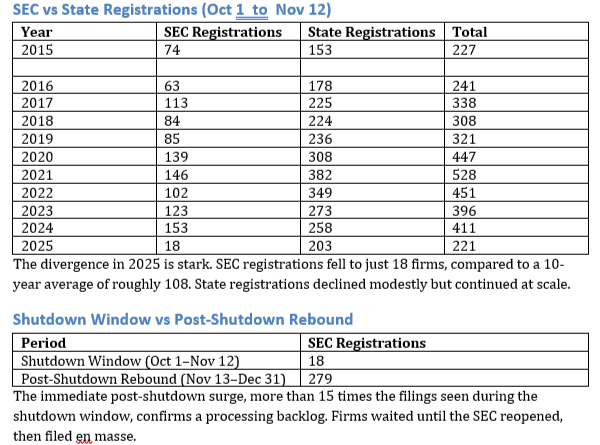
“What we saw was not advisors backing away from launching firms,” said Hesom Parhizkar, Co-founder & Chief Product Officer of AdvizorPro. “They were ready to go. The federal gate simply closed, and everything stacked up behind it. If firm creation demand had collapsed, we would see it in both datasets. Instead, state filings kept moving while federal registrations effectively stopped.”
“This rebound is the smoking gun,” Parhizkar added. “It proves advisors weren’t hesitating. They were stuck.”
Who Was Impacted
The shutdown disproportionately affected independent RIAs. All SEC registrations during the shutdown period were RIA filings, with virtually no broker-dealer-only or hybrid firms able to mitigate the disruption.
Implications for Advisors and Clients
It is important to understand what the absence of federal SEC approval means in practical terms. SEC registration is the legal authorization that allows an RIA to operate on a national basis, serve clients across state lines under a single federal framework, and scale beyond state level asset thresholds. Firms that meet federal registration requirements, generally those managing one hundred million dollars or more in regulatory assets under management or operating in multiple states, must receive SEC approval before conducting advisory business at scale. Without approved SEC registration when it is required, firms are typically restricted to state level registrations. This can limit or prevent them from serving out-of-state clients, impose administrative and compliance burdens tied to multi state filings, and in some cases cap growth. As a result, shutdown-related delays did not simply postpone paperwork. They temporarily constrained lawful business activity, forcing otherwise ready firms to delay client onb
But the shutdown’s impact extended beyond paperwork. Delayed registrations meant postponed firm launches, slower client onboarding, deferred asset transitions, and prolonged uncertainty for advisors and their prospective clients.
“For clients considering a move, timing matters,” Parhizkar noted. “When registration stalls, those decisions often get pushed, sometimes indefinitely.”
The 2025 government shutdown serves as a case study in how regulatory interruptions ripple through the advisory industry. The data makes clear that advisor entrepreneurship persisted, but federal bottlenecks delayed its execution, with real consequences for firms, clients, and markets.
*Photo by Andy Feliciotti: https://unsplash.com/@someguy?utm_source=unsplash&utm_medium=referral&utm_content=creditCopyText